Thursday, 15 May 2014

Climate Change and the Arts: Mary Oliver

After a long silence on this subject, I'm returning to my musings on climate change and the arts. Something that's been preoccupying me is the feeling of belonging, or lack of belonging. Where is the home of the human? Often environmentalists can feel guilty simply for living - that they cannot live without causing some sort of harm. This might be living on a low income, and having to buy Aldi's cheapest, unorganic or air-freighted food (in its plastic packaging), or having to buy cheap clothes, or travel. We feel we shouldn't have children. We feel we part of a species that's got out of control, like wasps, rabbits or cane toads. Such thoughts are not great for one's sense of self worth.

Are guilt and fear good reasons to be an environmentalist? It's good to be honest about these things - the fear one feels. But for a movement to grow, to embrace all, it must have love at its centre. Humans are animals - just like other animals, we need a home, and a place to belong. How can one celebrate life, while being ashamed and apologetic about one's own life, with all its imperfection and the inevitable harm it causes?

This poem by Mary Oliver is a meditation on guilt, belonging, humans and our place in the natural world. For me it helps reforge the links between the human animal and other animals (and non-animal life).


Wild Geese 

You do not have to be good.
You do not have to walk on your knees
For a hundred miles through the desert, repenting.
You only have to let the soft animal of your body
love what it loves.
Tell me about your despair, yours, and I will tell you mine.
Meanwhile the world goes on.
Meanwhile the sun and the clear pebbles of the rain
are moving across the landscapes,
over the prairies and the deep trees,
the mountains and the rivers.
Meanwhile the wild geese, high in the clean blue air,
are heading home again.
Whoever you are, no matter how lonely,
the world offers itself to your imagination,
calls to you like the wild geese, harsh and exciting --
over and over announcing your place
in the family of things.


Friday, 2 May 2014

Why ‘Thermal comfort in older houses’?

The energy group have chosen ‘thermal comfort in older houses’ as the topic for their next forum on 17th June. How come? Seeing as we did solid wall insulation only a year ago in June last year? Back in February we agreed this one would be on solar energy for water heating and the renewable heat incentive. The RHI for homes was expected imminently (and has now been announced - see our finance page).

We changed our minds because of the news that Cambridgeshire has won £5.7 million from the government’s Green Deal Communities fund. The bulk of this cash will be used to subsidise insulation of hard to treat homes including in conservation areas through the Action on Energy scheme (http://www.actiononenergy.net/). This is a wonderful opportunity that we must make the most of. For most people the insulation still won’t be free but there will be up to £6,000 support available per home. The money is supposed to be spent within one year so there is going to be a lot of pressure on Action on Energy to work quickly – we want to do what we can to make sure it is spent wisely.

‘Hard to treat’ is the term DECC uses for houses with solid walls, narrow cavities, steel frame construction and some other categories. They are called ‘hard to treat’ for good reason, especially our lovely old homes with traditional features like bay windows, decorative tiles and plaster on the outside and other special features on the inside. Whether we live in a conservation area or not, we love our homes the way they are so we want to be careful about how we improve them.

 The worst scenario would be if insulation led to damp – there was a presentation given at Ecobuild this year about external insulation leading to all sorts of problem due to poor workmanship and sloppy design. We don’t expect anything like that to happen here. South Cambridgeshire has a good track record with insulation for council tenants and work done under the Green Deal is guaranteed for 25 years. However, especially if you are contemplating work done by other suppliers it is sensible to be aware of the risks. At our last meeting we were discussing damp in general and heard about several examples where it seemed there was more condensation after insulation was installed. There was one case where both loft and cavity wall insulation were installed but because of the shape of the house some areas were missed out – and those were the areas where mould developed. In this case it should be easy enough to fix but it would have been even easier if the installer had predicted the problem and put in extra insulation at the start.

This is why we have chosen to explore insulation and other options in more detail and we are delighted to have found expert speakers - Jason Dorks from Natural Building Technologies and Jim Ross from Cambridge Architectural Research - who have many years experience of retrofit in older homes, including listed buildings. Our aim is to give people who might be considering insulation an idea of what to expect and what choices they will need to make. Some may decide not to go for wall insulation at all, preferring to concentrate on windows or managing draughts and ventilation. No two homes are the same and what is right for one won’t be right for another. Also we will have two group members as householders with recent experience. Patrick has just got to the end of a big building project on his home and Peter will be in the process of getting work done by Action on Energy. It is going to be a very interesting evening.

Tuesday, 22 April 2014

Woohoo for Wonky Veg!

Last Sunday was Cambridge's third Liberated Feast. [when I wrote that last sentence, it was indeed last Sunday. It is now three or so weeks ago...] If you haven't heard of Liberated Feasts yet, they are the brainchild of Jennie Debenham, and they are a celebration of food that supermarkets think we won't buy. This may be the banana that's not the same uniform size and shape of its brothers and sisters down the aisle, or else the rather over-enthusiastic thigh-width leek. At the Third Liberated Feast, the food that was served was a combination of food rejected by supermarkets and food donated by local farmers.

The Feast was held at St Paul's Centre on Hills Road, 7.30pm. We were all seated on long, Hogwarts-style tables, and serenaded by a variety of musicians. While food was somewhat long in arriving (with a handful of sweating volunteers ladling soup and hurrying in and out of the kitchen), getting to know my Feast-neighbours passed the time very nicely. I would estimate a hundred or so Feasters, most of whom were unknown to me. I was opposite Jessica, who works for the University press office, and Alistair, who works for the Red Cross.

The starter was a pale, parsnipy soup. Chatting to Liz Serocold and Bev Sedley, we couldn't quite work out what all the different flavours were - the combination was a treat. Following the soup, the main course was a fascinating mezze of sprouting broccoli, Baba Ghanouj, Unidentified-Greenish-Dip, kale crisps and other tasty tidbits. The desert was fruit crumble or chocolatey-biscuit thing. All courses were delicious and well worth the wait. The fact that this food would otherwise have been squashed beneath plastic in a hole in the ground somewhere as methane-oozing goo made one particularly appreciate it.

Many thanks to Jennie and all volunteers for liberating that feast for us!


Saturday, 12 April 2014

Creative Communities

Last weekend I was helping to organise the Creative Communities event, a Cambridge Carbon Footprint event led by Amy Ross and supported by Kate Honey and a few other fantastic people from a range of inter-faith backgrounds. The idea of the event was to get people from different religions to get together, and talk about how our beliefs affect our engagement with issues around the environment.

The idea is that all of us have something in common - a belief in something greater than us, which could be a way to find the inspiration and resources to make the necessary changes if we are to live consistently with what needs to be done to prevent further climate disasters. Inter-faith work can be delicate though, it's easy to find the differences before you find the commonality, and find yourselves moving further apart.

Aware of that, the event focussed on unity and used games, music and prayer to promote it. We played a match-and-chat game first of all, finding one other person with the same numbered ticket as us, and finding out more about their interest in the environment. We had some beautiful singing sessions, led by Kate, including one lovely tune that she had composed for the event. And also, a lovely pair of songs by a Baha'i gentleman called Peter.

One really remarkable thing about the day was that there were lots of children, and the event really seemed to meet their need for play and colour, thanks to the forward thinking of Portia and Jessa. They ran around and played happily throughout, reminding all of us that caring for the planet is also caring for the futures of the next generation of people.

Sunday, 30 March 2014

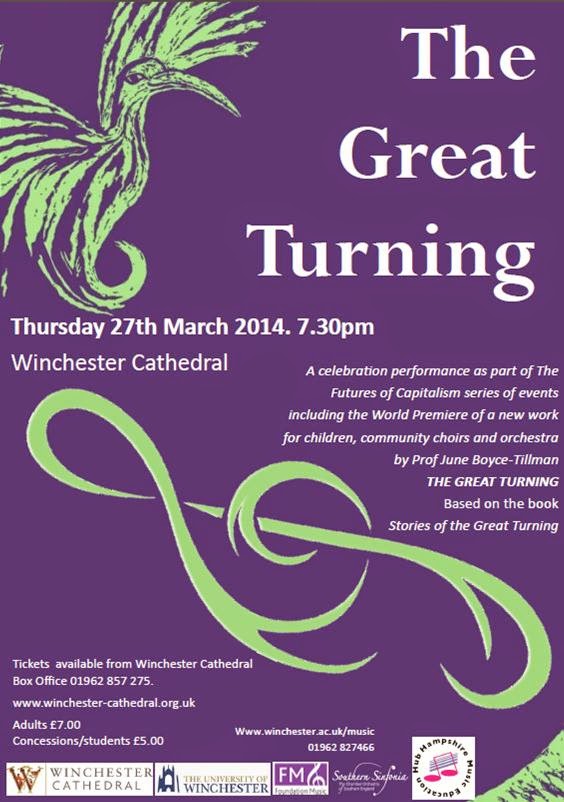
Climate Change and the Arts: The Great Turning

Hello all! After a long break (necessitated by looming composition deadline) I am back to blog about climate change/Transition/finding solutions to pressing world issues and the arts.

Winchester Cathedral nave
Last Thursday, I took the train down to Winchester, because that evening was the world premiere of The Great Turning, a massive musical work for a choir of 120+ and orchestra, composed by June Boyce-Tillman. The Great Turning is based on Stories of the Great Turning, edited by Peter Reason and Melanie Newman: a collection of stories of ordinary people doing extraordinary things to help a planet in peril.

The contributors to 'Stories of the Great Turning' include a former businessman, brought to a personal crisis by the sudden death of his wife and seeking a new direction in life; a PhD student turned whale-saving activist; a Frome-based poet who organised a Funeral for Extinct Species ceremony;  a married couple who install an innovative hydroelectric scheme at their property in Wales; a woman who launches a project to help disadvantaged young people grow vegetables in skips by King's Cross station; and a young woman who makes beautiful lingerie out of old clothes, amongst many others.

While the achievements of the contributors were not always flashy (nor always obviously 'achievements' or 'successes'), what was most heartening was that they changed the direction of the contributors' lives from life-draining to life-sustaining - a personal transformation we can see occurring planet-wide amongst individuals and communities.

Back to the music, and to Winchester Cathedral. June Boyce-Tillman is one of those fantastic contemporary composers you've never heard of (rather like all contemporary composers. New composition didn't stop with Vaughan Williams, by the way). Her specialism is in writing music that can be performed by everyone: children and singers who couldn't read music were all present in the 120+ singers who performed The Great Turning. Unlike much contemporary music, Boyce-Tillman's musical language is lyrical and accessible, while retaining emotional depth and sincerity.

The Great Turning was written for eight children's choirs, six community choirs and the Southern Sinfonia ( a professional orchestra). The work was structured in five sections, borrowing from the philosophy of one Joanna Macy: Act Your Age, Gratitude, Encountering the Darkness, Dare to Dream and Join Hands Across the World. The words were also written by Boyce-Tillman, who often lifted passages straight from the book and reworded them.

At around 8.20pm the sound of a gong resonated through the cathedral, followed by sombre, awe-inspiring chords in the heavy brass. What happened next had an extraordinary sonic effect: the children all processed down the nave,  beating together two pebbles. The sound of all the pebbles merged together into a hissing sound that swept along the cathedral, echoing into the all the recesses and up to the distant roof. As the children reached the quire, all voices were raised: 'Come, Gaian beings, we form parts of the earth. In honouring and sharing we bring new life to birth...'

The musical scope of the piece is too epic to sum up in a blog post. A high point for me was the distinctly pagan 'Glory be to Gaia', which owed much to renaissance liturgical music. There were also catchy sing-alongs for the children, such as 'Growth, *boom* growth *bang* economic growth *crash* more and more and more and more and more....' which I was humming all the way home. Probably the most succinct description of that particular economic ideology I've yet heard...

See here for Vala Publishers, the super co-operative who published Stories of the Great Turning!


Sunday, 23 February 2014

Follow the van

I was recently privileged to cater for the Food for a Greener Future conference, and got to hear some great talks in the afternoon after lunch. The most interesting part for me was the workshop right at the end, where Jacky Sutton-Adam and Duncan Catchpole discussed the Transition Food Hub and invited everyone in the audience to say something about what the concept meant to them.

This was a chance to get a consensus about what Cambridge needs, how to address perceived issues with food and community, and potentially begin a new profit-making spinoff from the Transition community. The appetite in the room was clearly for a space where sustainable food could be sold - and where people could come together. There was some murmurs about including educational activities, selling CamBake bread, and a definite preference for a venue somewhere central with a shopfront that could provide a visible site.

Potential visibility is a massive benefit that I would love to see the Hub project explore, and I'm going to restate my suggestion for a mobile hub after a little bit of research.

The challenge of a static site is that property rental costs are so high in Cambridge, that it seems hard to imagine even a temporary makeshift site being affordable. And as with the Cafe Project and Cambridge Carbon Footprint, being evicted by the landlord would be quite a setback after working really hard to get people turning up. Perhaps there is a way to find a permanent home for a sustainable local food enterprise, I would love to see this, but I am afraid that it might be too well-hidden to get the custom it deserves.

I'd like to seriously think about having a Transition food truck, fitted out to run off solar energy and cooking oil, and weaving a route through business parks, community kitchens and schools. The benefit of this approach would be that the vehicle acts as both marketing and point-of-sale, popping up in the city and the villages making people think "What's that beautiful, positive, hopeful thing doing here?".

Transition doesn't have the resources to advertise heavily in the press or the busy places, but the word of mouth and social networks have a limited extent. In fact there were some legitimate concerns at the conference that the attendees were white, middle-class, middle-aged and upwards, and the message wasn't getting out beyond that very small group. A hub bus would be able to both sell to and engage with diverse groups, and learn a great deal about what is really in demand in the wider populace. Organic food is seen as expensive, vegetarian food is seen as bland, these ideas can be challenged more effectively by lunches than by lectures.

A bus or a van would also be flexible enough to respond to opportunities - travelling to festivals and invitations, while learning which areas generate enough revenue to maintain running costs. It would be able to resell on behalf of community bakeries, chefs and farms if the terms were good, perhaps even working with Outspoken couriers to fulfil deliveries for each other.

Spare room could either be used for storing additional food, seats for outdoor occasions, or projector equipment for showing Transition related films. The van might even be kitted out as a mobile library for some situations.

Financially, most of the cost would come in terms of set-up, rather than in terms of monthly expenditure. This seems more suited to the type of money that could be raised from a council or developer grant, or from investment - a predictable cost that can be budgeted, and a liquid asset.

Perhaps the team who take this on could focus on generating turnover to begin with, turning up at large office buildings with delicious food to buy, and proving the concept of the hub bus so that the outreach and education activities can be gradually brought online while keeping the balance sheet healthy. Opportunities to reduce food waste and to create community will reveal themselves every day, and a digital presence can also take shape.

The next step would be to contact green businesses who have tried similar things, The Big Lemon and Buddhafields Cafe for two examples, to seek out more advice about costs and processes. I will offer to do that myself if there is a enough interest in the idea.

The Big Lemon is a public transport company in Brighton which uses cooking oil for fuel
http://www.thebiglemon.com/aboutUs/FAQs/default.asp

A detailed breakdown of setup costs for a Food Truck in New York, in dollars.
http://upended.net/post/25574021175/foodtruckstartupcosts


Wednesday, 19 February 2014

Community Energy Trumps Gales and Romance

Valentines Day this year brought no let-up in the storms so I was really pleased to see about 40 people come to the Transition Cambridge Energy Group forum on Community Energy – many of them even came by bicycle.  The program featured three local schemes in various stages of completion: Mike Brettle talked about the Gamlingay Wind Turbine project, installed in May last year, Andy Rankin described the Reach Solar Farm project, now waiting for planning permission, and Stuart Dyer gave us an update on the Cambridge Community Energy company, which hasn’t definitely got a site yet but we are sure enough to go ahead and register the co-op. Also Paul Rewrie of PR Accountants described some tax breaks available to renewable energy investors. Cambridge is rather a slow starter compared to Oxford, with several installations already completed, but people commented to me how exciting it is that things are happening here too at last.

There didn’t seem to be much controversy about whether or not community energy generating schemes are a good idea. There were questions about the financial side: Can I use my pension fund to invest? (Answer yes but you won’t get all the tax breaks you do normally) and: Will you only allow local investors? (For Reach it seems that local will definitely include Cambridge).

Also there were concerns about the equipment: Which bit of a wind turbine usually fails after 20-25 years? (answer none, they may last much longer, but they are often upgraded before then anyway).

Mike made some very interesting recommendations about how to get support from local residents – their planning application got twice as many positive comments as negative ones which is amazing for a wind turbine project. The CCE scheme probably won’t need planning permission but Reach is in planning now and we are keeping our fingers crossed.

You can download some of the slides from the presentations on the CCE website here and on the Reach website here. Also both websites let you signup for a newsletter and if you are interested in helping to get CCE going let me know or use the email address on the website contact page.